I want to start by telling you all about one of my favourite memes.
It started way back in 2018 when The Sun (a right-wing UK tabloid so scurrilous in its journalism that it’s boycotted by the entire city of Liverpool) posted an article. It was a standard truth-baiting piece full of outrage about how the curriculum was being changed to pander to ‘woke’ literature students.
The teaching in question? That students were now being taught that the real victim of Mary Shelley’s ‘Frankenstein’ was actually the monster!
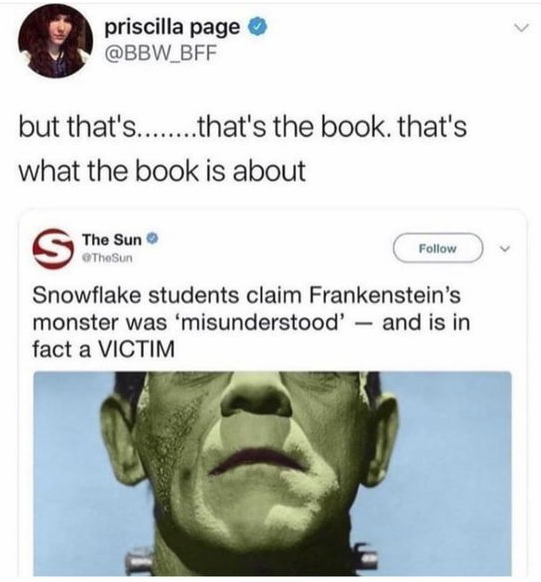
This was gold dust to the literary spheres of then-Twitter and Tumblr (a platform that really loves its monsters) who were quick to point out that this had always been the point of Frankenstein.
The outpouring of sarcastic tweets and tumblr posts really made my week and none more so than this stupendous offering:
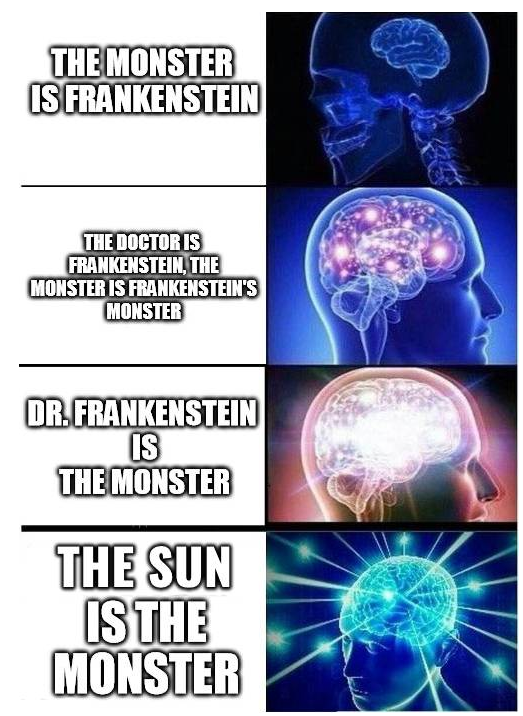
Okay, I added the bit about The Sun on the end myself, but honestly someone must have shared this before me.
The story above contains almost all the things that make stories about monsters so appealing to me.
~ The monster who is not really a monster.
~ The person who only behaves as a monster because he’s treated monstrously.
~ The protagonist who is the creator of his own undergoing (HUBRIS!).
And, of course,
~ the realisation that the true monster isn’t a person or a creature, but a structure puffed up by hate.
When I started writing stories on the internet in the hope they might make my friends smile, some of the first ones were about monsters. Just one or two line jokey stories about heroes and monsters making out. And as I wrote more, it turned out that I had a lot of feelings about monsters bubbling beneath the surface. So I began to write about them with greater frequency.
Thinking about it, they’d been bubbling for quite a long time. So when I was writing about a subject like ‘monsters’ – something that is so fearsome and so other – I was actually writing something deeply personal to me and/or to those dear to me. And by writing about monsters and what makes them monsters, I got to write about what it is that makes something monstrous … and how often that isn’t the monster themself.
I’m four and I’m reading a pop-up book about St George and the dragon. The pop-ups are gory and spiky and probably massively age-inappropriate. The dragon is brutal, bestial and captivating. I love St George with all my little paladin-ish heart, but a small part of me knows that it is the monster that has made him.
…
I’m seven (I think) and I’m running my finger over the page, tracing the path of a labyrinth. When I reach the middle, that’s when Theseus will find the Minotaur and fight it. I had a lot of books like this – myths told as cartoons – and they always had a monster. Some of the monsters were gods. I have vivid memories of reading about Theseus while waiting in sports halls.
The other vivid memories of sports halls I have are largely of being bullied by kids I didn’t understand. At least the baddies in the books made sense.
…
Skip forward, and I’m ten and asking my teacher if the class can read The Wizard of Earthsea together. It’s a weird, entrancing and uncomfortable read – the dragons are ancient, alien and sharp as a tack. The monster of the book is one that the hero made himself out of hubris. A monster that, in the end, the hero names as himself.
My teacher tells me that books like that are for people like her and me, and the rest of the class won’t enjoy it. What I hear is: this is because the rest of the class are normal. The gulf I’d already begun to feel between me and the other kids grew a little wider.
…
Later that year, I punched a boy in the face for basically no reason. Well, I can remember the reason: he’d found a pen that I had lost. When he found it, I couldn’t imagine any version of the world where this wasn’t a trick of some kind. I was an angry child a lot of the time. When I was old enough to try to talk about that anger, I called it a dragon.
…
When I’m 11, a bunch of boys are whispering in class about who they’d fancy, if they actually fancied boys.
It’s a weird and welcome change from the cries of ‘gay’ and ‘gaylord’ that are the common lunchtime chorus (and part of the reason I spent most of my lunches wandering the corners of the playground, circling my favourite tree and pretending to fight monsters).
So my best friend asks me: Who’d you fancy, if you fancied boys? And I say: ‘you’. He flinches back and something changes between us.
It won’t be for many years after this that I come out as bi and most days it still feels like I’m faking to seem ‘more queer’. I often wonder who I’d be without that constant background radiation of homophobia in those days.
…
I’m 18. I’m about to go off to university. I’m talking to a friend on MSN messenger about my relationship and what to do about it – the conversation goes more of less:
Me: “Y’know, I care a huge amount for my girlfriend, but I’m probably about to be in a place where I meet a bunch of new and interesting people and maybe I don’t want to be in a relationship when I get there?”
My friend: “Wow, that’s cold…”
Me: “…is it?”
My friend: “Yeah. When I’m with my boyfriend, it’s like no-one else exists.”
I can look back on this now and realise it was one of the first times that it became clear that I am, in many ways, wired to be non-monogamous/polyamorous. Now, I can see that as a natural part of me that I can work around if I want to, but I can’t fundamentally change. At the time … I felt broken. Monstrous.
A short while later, my girlfriend broke up with me, because I was going away to university and boys who go off to university ‘always cheat’.
…
I’m on holiday with a few friends in our early twenties. We’re in a bar and we’re discussing comics and mythology. Lucifer comes up.
I surprise myself by discovering I have pretty strong feelings about the importance of Lucifer as an embodiment of will. In time, this will form the basis of my journey to a new understanding of my faith, as I try to reconcile my Christianity with my love of this fallen angel and of the gods and monsters I’d been soaking myself in since childhood.
I’ve been writing about angels and demons ever since.
…
It’s 2021 and I’m in therapy. I’m trying to thread together the common themes through some of the most painful parts of my life, the things that make me feel monstrous and – on my worst days – make me want to not exist.
We talk about dragons and angels and love and the monsters that we make ourselves.
We give one of those little monsters a name. Later, a dear friend draws it. Another makes it into a plush toy. We turn it into a friend – something cute and grumpy and trying its best.
I am learning how to care for my monsters, which – in the end – were mostly needs I wasn’t listening to.
…
Monsters are threaded intimately through my life.
This is true of me and a lot of the people close to me.
Maybe it’s true for you too.
Getting to know those monsters better through stories has been, at the same time, how I get to know myself.
It’s also how I tell my loved ones what it is that I love about them, because I love their monsters.
And it’s how I try to reorder the world, to see what wounds we skin over by calling monsters, and to understand the behaviours that I truly do see as monstrous.
What I’m trying to say is: when I put together a collection of stories about monsters, what I’m really doing is making a catalogue of edge cases and extremities and outsiders.
I’m finding the things that make me feel scared and vulnerable, and I’m bearing my neck to them.
And I’m finding that, most of the time, they don’t bite.
I’m discovering that so many of the things that scare us are things that we love.
I’m working out why they scare me, and I’m trying to decide who or what should fear us instead.

Monstrous Ink is a collection of 52 very short stories that delve into what it means to be a monster and the power of reclaiming what (we fear) is monstrous inside ourselves.

© Inspired Quill 2026 | Website by Big Red Web Design
